
Approaches & States: Great RPG Mechanics
#RPGMechanics Week Two


All characteristics, stats, and attributes for characters are abstractions. They’re a bundle of ideas to which we assign some kind of rating. But for the most part we have the sense of the “reality” of these stats. Strength means strength: lifting, climbing, applying force. We can imagine the concrete effect of it in the world. We can picture as well a Dexterous person: moving quickly, keeping their balance, adept at sleight of hand. Even the more abstract classics like Wisdom have a set of aspects in the game reality linked to them, like being able to suss out the truth, judging character accurately, understanding esoteric concepts.
Many games give us a description of what the characteristics mean, but our real understanding comes from where they’re used. We see which skills rolls or moves are linked to which attributes. Maybe we have a little fudge room to decide, especially for something like Mutant System or 2d20 where you add a stat to a skill value. Maybe a player argues that this grapple check is more about finesse than power. That’s a common negotiation– and once we’ve opened that door, it leads to some other ideas.
Fate Accelerated may not be the first place where I saw something like Approaches, but it's the game which made the idea stick for me. In FA when you go to do something, you say how you’re doing it: what it looks like, what makes this cool. Are you doing it Carefully? Cleverly? In a Flashy way? Forcefully? Quickly? Sneakily? The mode you choose colors the action and expresses character. Your relative strength in these approaches also says a lot about who you are. This builds in a question often glossed over when folks say “I swing again” and roll. That question is: how are you doing that?
This move to approaches has a design implications: de-coupling particular actions from particular stats. Some players have a hard time when there aren’t guidelines about what to invest their stat points in. On the designer’s side, it takes out some easy feats and modifiers, like being able to use X stat in place of Y when doing Z.
Fraser Simon’s use of States in The Veil, builds on the approaches concept. It’s one of my favorite PbtA games. Here, rather than conventional attributes, you have emotions: Mad & Peace; Sad & Joy; Fear & Power. When you go to do an action, you say which one dominates. You have room to decide if that describes the feeling you're pushing against, the one driving you forward, or some other interaction. It uses a version of the feeling wheel to help players articulate their character’s state in that moment.
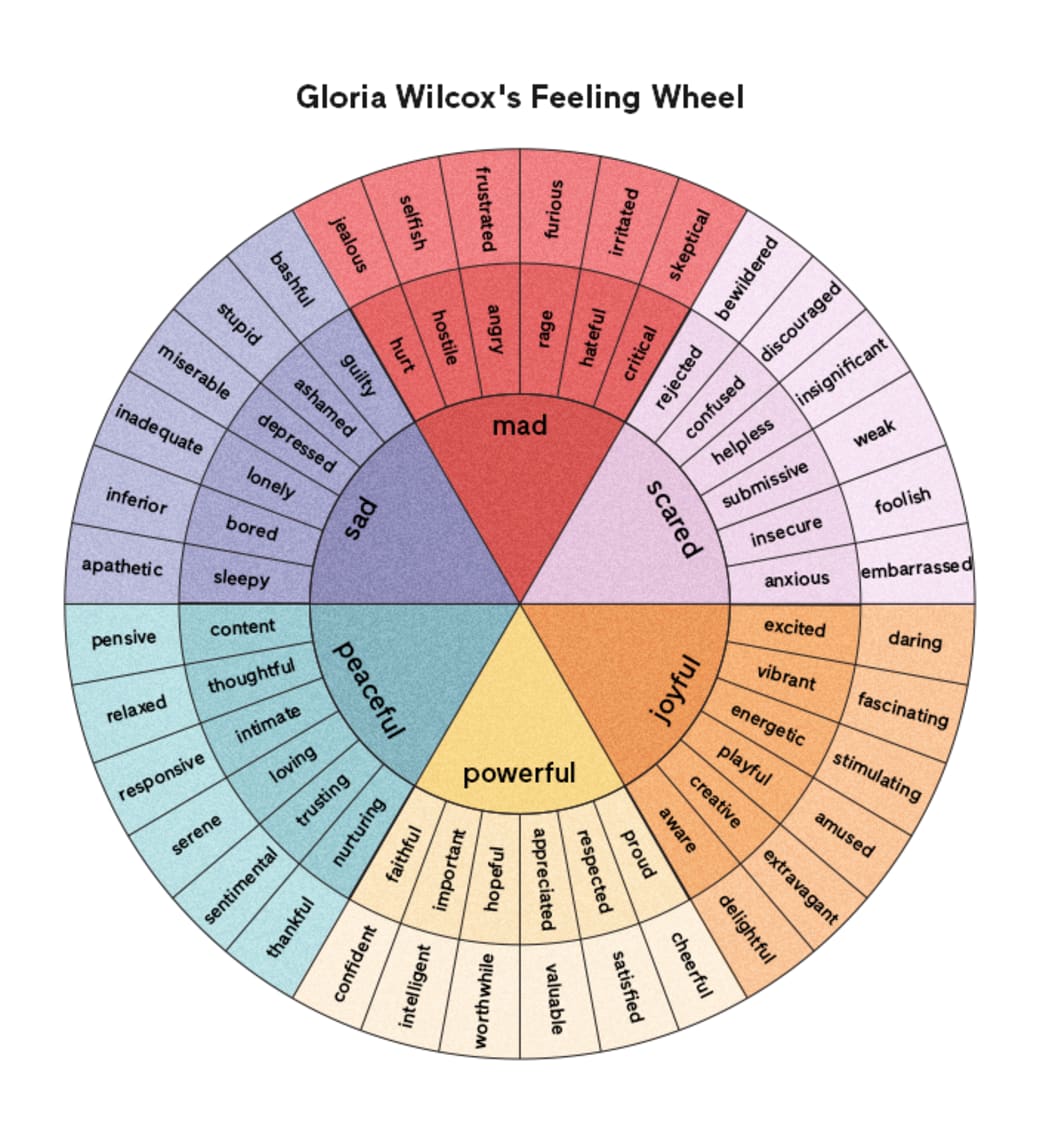
Part of the point of The Veil is to explore the emotional side of cyberpunk stories, and this mechanics continually pushes you to consider that. It also has a nifty mechanical answer to the question “why wouldn’t I always roll with my best stat?”. Every time you roll a particular state you mark a check box for it. When you mark the 5th box in a state, you spike it out. That pushes you further into that emotion at a penalty until you act to reset yourself. You can manage that in play– each emotion has a paired emotion and when you put a mark on one side (say Peace) then you remove a mark from the other side (Mad). In play, once folks get used to the rhythm, it is dynamite.
And if you’ve played Hearts of Wulin, you’ll see where I got the idea for using Elements, associated with certain feelings and aspects, for stats. I have a couple of innovations there, but my favorite is that harm locks certain elements, meaning you can’t roll with that element until someone helps you or you have a montage to clear yourself.
I’ve come to really love this approach. It does have a small cost in time and cognitive load. You always have a moment of consideration before you roll. But having done it enough I feel weirdly straitjacketed sometimes when I hit a game with a very locked down characteristic-to-specific action system.